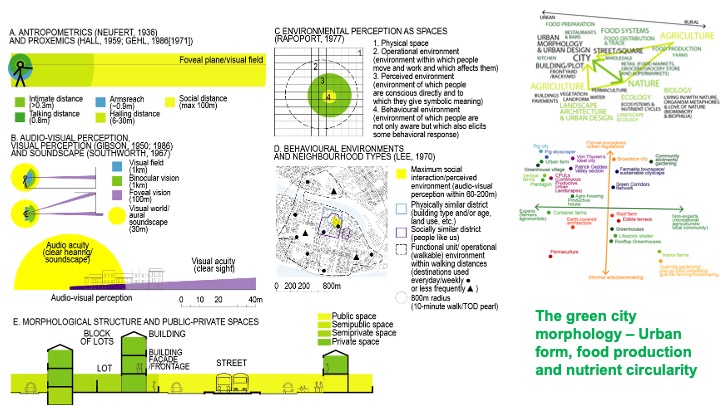
The green city morphology – Urban form, food production and nutrient circularity
The FOCUSE team, consisting of Todor Stojanovski (KTH, Sweden), Anna Zaręba (University of Wrocław), Alicja Krzeminska (University of Wrocław), Mosen Farhangi (IVL, Sweden), and Michael Martin (IVL, Sweden), published the article: The green city morphology – Urban form, food production and nutrient circularity, prepared for the XXXI International Seminar on Urban Form, held from September 16–20, 2024, in São Paulo, Brazil. The article addresses the role of morphological analysis in shaping the concept of agroecological urbanism. The green city is an urban planning concept that integrates greenery, landscapes, and agricultural elements into the structure of urban spaces to create a sustainable urban form. Its goal is to support a high quality of life in harmony with nature, increase biodiversity, and ensure a circular flow of resources. This paper presents the concepts of agroecological urbanism and the green city, analyzing their visions, scales, and elements in the context of urban design based on morphological analysis. Urban design involves a three-dimensional analysis of urban spaces, while urban morphology views cities as a hierarchy of structural elements, such as street layouts, plots and their aggregation into blocks, buildings, and land-use patterns. The integration of urban morphology, landscape architecture, architecture, urban agriculture, and landscape and industrial ecology creates new opportunities for sustainable development. An interdisciplinary approach allows for a better understanding of the needs and challenges associated with creating productive green cities that combine ecological, social, and economic functions into a cohesive urban structure.