Partners
Grönska Stadsodling
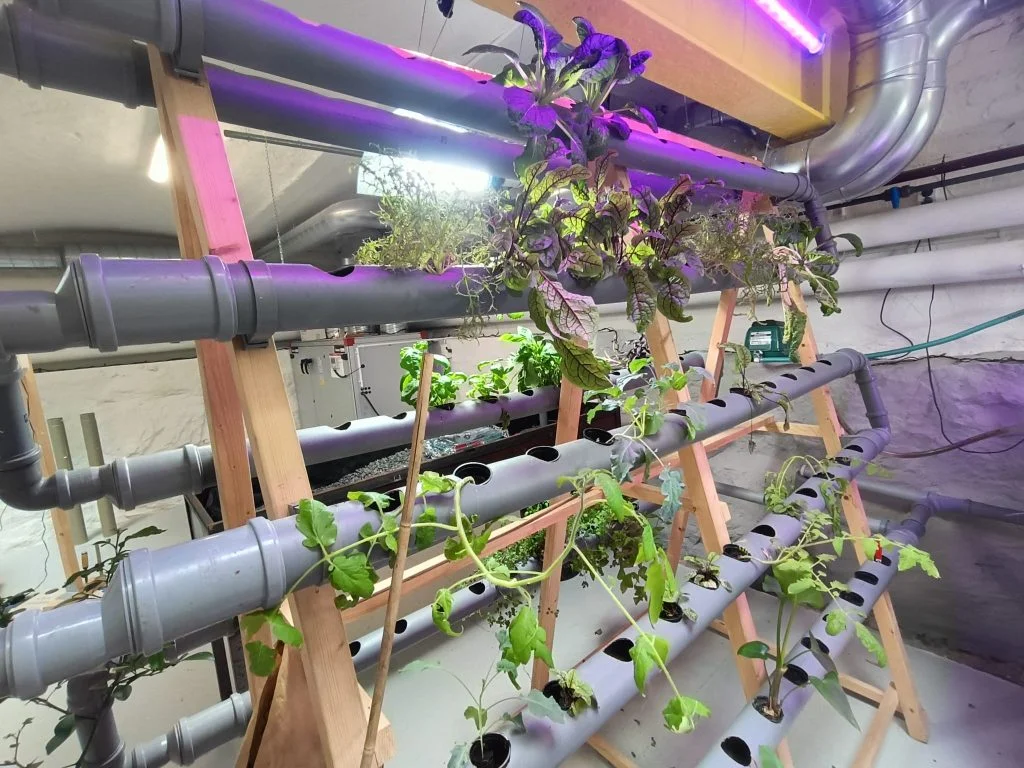
Grönska Stadsodling is a Swedish agricultural technology company that develops indoor vertical farming technology. Grönska began its operations in 2015 in the basement of a building, where it developed an indoor vertical farming system. From 2019 to 2022, the company operated one of the largest commercial vertical farms in Europe. Currently, it focuses on modular vertical farming units (“Grow-Off”).
IVL Swedish Environmental Research Institute (Project Leader)
IVL Swedish Environmental Research Institute is an independent, non-profit research organization managed by a foundation that was established in 1966. It brings together the largest group of environmental experts in Sweden, employing around 400 scientists focused on solving environmental problems worldwide. IVL is the leader of a project funded by Vinnova, covering urban agriculture topics. Other research, funded by Formas, focuses on detailed assessments of hydroponic urban farming systems (in collaboration with Grönska Stadsodling). IVL is leading the CircVertFarm project, aimed at developing and analyzing more economically efficient systems for urban vertical farms. IVL also co-leads a project funded by the Belmont Forum, JUST GROW.
KTH Royal Institute of Technology
The Royal Institute of Technology (KTH) in Stockholm is one of Europe’s leading technical and engineering universities and the largest Swedish research and educational institution in the field of technology. The Department of Sustainable Development, Environmental Science, and Engineering (SEED) conducts research focused on the sustainable development of society. KTH leads the Sustainable Urban Food Laboratory (SUF-Lab), which has conducted and currently leads several research projects aimed at improving the resource efficiency and circularity of urban farming systems.
City of Wrocław
The Wrocław Municipality is a local government unit that places special emphasis on sustainable development, urban greenery, sustainable resource management, waste management, and the implementation of nature-based solutions (NBS) as tools for climate change adaptation. In 2020, Wrocław adopted the Urban Climate Change Adaptation Plan, a document that sets the direction for the city’s development. Wrocław is involved in several projects:
- Grow Green – funded by the EU Horizon 2020 program, focused on demonstrating innovative nature-based solutions in cities.
- FoodSHIFT2030 – also funded by the EU Horizon 2020 program, aims to develop a toolkit for low-carbon, circular food production. This system will promote community gardens, providing residents with direct access to greenery and small-scale food production (vegetables and fruits).
- Fair Local Green Deal – a program initiated by ICLEI, coordinated by ICLEI, and funded by the Porticus Foundation. The project aims to implement the European Green Deal’s provisions at the local level. One component of the European Green Deal is the “Farm to Fork” strategy for developing a healthy and environmentally friendly food system.
- Making Cities Resilient 2030 Hub – focused on resilience and climate change adaptation. MCR2030 is an initiative launched by the United Nations Office to support local governments in enhancing their resilience.
On November 22, 2022, Wrocław became the eighth MCR2030 Resilience Hub in Europe. The city’s aspiration is to focus on nature-based solutions (NBS) as tools to help build its resilience to climate change.
Related links:
Skellefteå Municipality
Skellefteå Kommum is the second largest municipality in the region of Västerbotten in Sweden. The Kommum covers 9,956 square meters and is home to almost 75,000 people, although it is growing rapidly. The economy of Skellefteå has largely been driven by mining but it is diversifying with the establishment of affordable renewable energy, which attracted Northvolt to build a large battery plant. For this reason, Skellefteå is experiencing a renaissance by offering people good employment opportunities and quality of life. Skellefteå experiences subarctic climate to continental weather patterns which is moderated by the Bothnia Bay offering an interesting case to explore the implementation of urban food production in this part of Northern Europe.
Stockholm Invest
The Department of Sustainable Development, Environmental Science, and Engineering conducts research focused on sustainable urban development in Stockholm. The department’s research includes studies on industrial ecology, urban and industrial symbiosis, urban agriculture, new food resources (such as algae), and methods for assessing sustainability in food production.
Universitat Autònoma de Barcelona
The research group Sostenipra operates within the Institute of Environmental Science and Technology at the Universitat Autònoma de Barcelona (ICTA-UAB), which has held the prestigious “María de Maeztu” Center of Excellence designation from the Spanish Ministry since 2020. The Sostenipra group has expertise in urban agriculture and its sustainable development and has gained experience in managing and designing modern rooftop greenhouses (iRTG). Since 2015, several experiments with hydroponic rooftop cultivation have been conducted at ICTA-UAB, demonstrating the technical, environmental, economic, and social viability of modern urban rooftop farming practices.
University of Bologna (UniBo)
The Department of Agricultural and Food Sciences (DISTAL) at the University of Bologna (UniBO) plays a leading role nationwide in research, teaching, and consultancy in the fields of horticulture, crop production, sustainable agricultural systems, and ecology. In 2010, the RESCUE-AB team was established within DISTAL, which coordinates several projects, including the H2020 project “Food Systems in European Cities” (FoodE; 2020-2024) and is a partner in several international projects focused on urban agriculture and promoting sustainable food production systems, including Erasmus+ “Local Food Trace” (LOFT, 2022-2025), HORIZON-RIA “Integrated and Circular Technologies for Sustainable Food Systems in Urban Regions in Africa” (INCiTiES-FOOD, 2023-2026), and Erasmus+ “BEST Microgardens – Tackling Food Insecurity by Promoting Ecological Microgardens in Europe” (BEST Microgardens, 2021-2024).
University of Wroclaw
Wydział Nauk o Ziemi i Kształtowania Środowiska Uniwersytetu Wrocławskiego jest jednym z największych ośrodków badawczo-dydaktycznych w Polsce zajmujących się naukami o Ziemi. Obszary specjalizacji obejmują między innymi: geologię środowiskową, geografię fizyczną, geografię społeczno-ekonomiczną, gospodarkę przestrzenną, planowanie urbanistyczne oraz ochronę i rozwój środowiska. Wydział Nauk o Ziemi i Kształtowania Środowiska prowadzi programy w zakresie projektowania i planowania zrównoważonego rozwoju miast.